Showing posts with label Meat. Show all posts
Wednesday, April 27, 2011
The Black Hoof
You should go to Toronto and eat at The Black Hoof. Unless you're a vegetarian. If so skip to the next post.
C was off at a bachelor party, Susie was in London, so Nathan (from Back off Ladies, He's Taken) and I shared a an epic set of moments over a fabulous meal. Each dish. Each mouthful was transcendent. I'd tell you what we ate but it doesn't matter because the menu will have changed by the time you get there. Trust them. Eat everything. Let them pick your wine. Let them bring you a cocktail. Put your appetite in their capable hands and enjoy something special.
"Everything is made: from the charcuterie to the cocktail garnishes. Things are foraged when possible. It’s a meat and off-cut centric menu to be sure, but there is always a fish option. There is much attention to detail in the service. The atmosphere is boisterous and casual."
So much love.
Wednesday, February 16, 2011
Shot
I love that getting shot in your game is a Thing. Considered acceptable. Maybe even a bit cool and desired. Because then it is the Real Thing. And that adds a certain air to the meal, doesn't it?
I mean, as long as you don't break a tooth.
Sunday, January 16, 2011
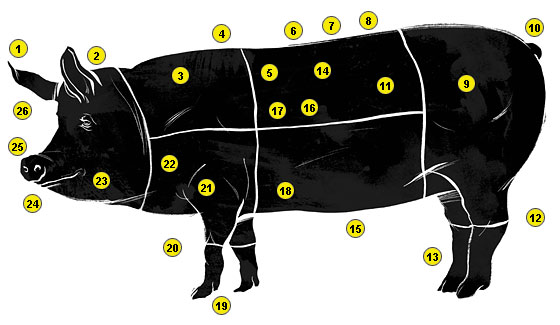
Know Your Pig
![]() |
| Illustration by Kagan McLeod from the New York Magazine article |
Wednesday, November 24, 2010
Roasted Tomato and Sausage
When does a recipe become your own? How many times do you have to make it without following the original step by step to call it yours? How many changes, however slight, give you ownership of a set of instructions?
I think about that often while reading food blogs.
After the April sausage making class we had an abundance of sausages. In fact the freezer was quite full and it's only now that the numbers have dwindled enough for me to think about purchasing sausages again. For awhile we ate our homemade, artisan sausages with glee and they did in fact taste delicious - pride does add flavour! But then I started getting bored and looked around for sausage inspiration. I found a recipe on Jamie Oliver's site for sausages roasted with tomatoes to form a lovely sauce. Excellent. I followed the recipe and made the dish. Great - delicious, absolutely a make-again. And dead simple.
So the next time I glanced at the recipe and then went forth and made some changes. And then I made it again and didn't consult the recipe. And now, while the inspiration may have come from Jamie Oliver, the recipe is mine and it is one of my favourite comfort foods at the moment.
For two
Four sausages (Italian, cumberland, whatever. Preferably homemade ;)
A small mountain of cherry/grape tomatoes. I usually use a punnet and a half or so.
4 cloves of garlic, still in their skins
Herbs!
Rosemary, a sprig or two, finely chopped.
Thyme, three sprigs or so, finely chopped (or about a teaspoon of dried).
Oregano, half a teaspoon or so
Olive Oil
Balsamic vinegar
Salt and Pepper
The tomatoes get thrown into a roasting tin, the herbs sprinkled over top, douse with a bit of olive oil, be generous. Then add a tablespoon of balsamic vinegar. Mix about. Toss in the garlic.
Roll the sausages in the oil and place them on the tomatoes. This whole thing goes in the oven (180 degrees) for about 45 minutes. Turn the sausages and mix up the tomatoes about half through. You want them to roast and blacken a bit. Sometimes my sauce is too watery and then I pop in on the stove to boil away and simmer, adding the sausages at the end to warm up before serving.
It's unctuous and herby and warm and served over polenta that's got a shocking amount of butter and cheese in it it is one of my favourite meals of the moment.
The thing is, we are actually almost out of sausages and while the class was fun I don't really see us going back... so we'll have to BUY sausages like regular people. Ew. How common.
I think about that often while reading food blogs.
After the April sausage making class we had an abundance of sausages. In fact the freezer was quite full and it's only now that the numbers have dwindled enough for me to think about purchasing sausages again. For awhile we ate our homemade, artisan sausages with glee and they did in fact taste delicious - pride does add flavour! But then I started getting bored and looked around for sausage inspiration. I found a recipe on Jamie Oliver's site for sausages roasted with tomatoes to form a lovely sauce. Excellent. I followed the recipe and made the dish. Great - delicious, absolutely a make-again. And dead simple.
So the next time I glanced at the recipe and then went forth and made some changes. And then I made it again and didn't consult the recipe. And now, while the inspiration may have come from Jamie Oliver, the recipe is mine and it is one of my favourite comfort foods at the moment.
For two
Four sausages (Italian, cumberland, whatever. Preferably homemade ;)
A small mountain of cherry/grape tomatoes. I usually use a punnet and a half or so.
4 cloves of garlic, still in their skins
Herbs!
Rosemary, a sprig or two, finely chopped.
Thyme, three sprigs or so, finely chopped (or about a teaspoon of dried).
Oregano, half a teaspoon or so
Olive Oil
Balsamic vinegar
Salt and Pepper
The tomatoes get thrown into a roasting tin, the herbs sprinkled over top, douse with a bit of olive oil, be generous. Then add a tablespoon of balsamic vinegar. Mix about. Toss in the garlic.
Roll the sausages in the oil and place them on the tomatoes. This whole thing goes in the oven (180 degrees) for about 45 minutes. Turn the sausages and mix up the tomatoes about half through. You want them to roast and blacken a bit. Sometimes my sauce is too watery and then I pop in on the stove to boil away and simmer, adding the sausages at the end to warm up before serving.
It's unctuous and herby and warm and served over polenta that's got a shocking amount of butter and cheese in it it is one of my favourite meals of the moment.
The thing is, we are actually almost out of sausages and while the class was fun I don't really see us going back... so we'll have to BUY sausages like regular people. Ew. How common.
Sunday, January 17, 2010
On Meat
I'm a flexatarian with four kilos of pig in my fridge. (See the photo of one I prepared earlier - that one was even bigger!)
(As much as I hate cutesy terms and non descriptors I can identify with flexatarian. I'm not a vegetarian. I enjoy meat and I want to continue eating it. I'm not a pescatarian, a term which annoys me. So someone who doesn't eat very much meat and who regularly chooses veggie over meaty- yeah, I can work with that. )
Focus - FOUR kilos of pig. A pig shoulder which is currently nestled in the fridge with a rub (rosemary, fennel, garlic, chili, preserved lemon) waiting for the morning when I will pop it into the oven for six or so hours.
How does a flexitarian justify four kilos of pig? Isn't a flexi just a lazy, or uncommitted, vegetarian? Isn't FOUR kilos rather excessive?
Let me climb on my soap box and tell you want I think about meat...
I like bacon. I think there are few homier meals than a roast chicken. Steak makes me salivate. Food is a celebration and for us Anglo Saxons a big chunk of meat is traditionally the centerpiece. Food equals love. So I can't imagine becoming a full vegetarian and giving up these bits of comfort and love and tradition. But learning about meat, all about it, from health issues to ethical to environmental to consumer issues, makes it very difficult for me to eat it the way I used to and the way I cook and the way I eat has shifted substantially in the last few years.
We eat much less meat than we used to. It features as the centerpiece of our meals maybe once a week and gets used as flavour and side bits two or three (two rashers of bacon in pasta, a sausage in soup). The meat that we do eat comes from either the butcher in Broadway Market or the Ginger Pig and is brought up and butchered in a way that I feel good about. I feel good knowing that the meat that I buy satisfies every tickbox I have against the long list of "Meat is Bad".
I recognise that it is expensive. I recognise that I'm really lucky that I have these options. But it is a choice and a commitment that I am happy to make. (And since this is my blog it is my soap box and I can sing the praises of happy meat to my hearts content.)
As for the FOUR kilos of pig in the fridge. It's a lesser known cut, so less expensive, will be succulent and last us for many many meals- or at least one great meal with friends.
Join me on my soap box next time for "Why the tuna in your sandwich is like eating elephant".
(As much as I hate cutesy terms and non descriptors I can identify with flexatarian. I'm not a vegetarian. I enjoy meat and I want to continue eating it. I'm not a pescatarian, a term which annoys me. So someone who doesn't eat very much meat and who regularly chooses veggie over meaty- yeah, I can work with that. )
Focus - FOUR kilos of pig. A pig shoulder which is currently nestled in the fridge with a rub (rosemary, fennel, garlic, chili, preserved lemon) waiting for the morning when I will pop it into the oven for six or so hours.
How does a flexitarian justify four kilos of pig? Isn't a flexi just a lazy, or uncommitted, vegetarian? Isn't FOUR kilos rather excessive?
Let me climb on my soap box and tell you want I think about meat...
I like bacon. I think there are few homier meals than a roast chicken. Steak makes me salivate. Food is a celebration and for us Anglo Saxons a big chunk of meat is traditionally the centerpiece. Food equals love. So I can't imagine becoming a full vegetarian and giving up these bits of comfort and love and tradition. But learning about meat, all about it, from health issues to ethical to environmental to consumer issues, makes it very difficult for me to eat it the way I used to and the way I cook and the way I eat has shifted substantially in the last few years.
We eat much less meat than we used to. It features as the centerpiece of our meals maybe once a week and gets used as flavour and side bits two or three (two rashers of bacon in pasta, a sausage in soup). The meat that we do eat comes from either the butcher in Broadway Market or the Ginger Pig and is brought up and butchered in a way that I feel good about. I feel good knowing that the meat that I buy satisfies every tickbox I have against the long list of "Meat is Bad".
I recognise that it is expensive. I recognise that I'm really lucky that I have these options. But it is a choice and a commitment that I am happy to make. (And since this is my blog it is my soap box and I can sing the praises of happy meat to my hearts content.)
As for the FOUR kilos of pig in the fridge. It's a lesser known cut, so less expensive, will be succulent and last us for many many meals- or at least one great meal with friends.
Join me on my soap box next time for "Why the tuna in your sandwich is like eating elephant".
Wednesday, July 08, 2009
Adam's BBQ
Adam had a BBQ last weekend. I stressed about what to bring. I mean, we don't get to BBQ that often, so it had to be good. But it also had to be eatable with a bunch of strange people in a backyard, so I couldn't exactly go get steaks or do burnt aubergine.
So I made kebabs. Fancy ones. With rosemary sticks from the balcony. I've always wanted to do that. They look fancy and automatically special and the frangrance of the roasted rosemary was gorgeous.
Rump steak cubed and marinated in lemon zest, garlic, sage and olive oil.
Before

Cooking

We ate them in pita bread with salt and pepper chips and beer. A proper BBQ.
So I made kebabs. Fancy ones. With rosemary sticks from the balcony. I've always wanted to do that. They look fancy and automatically special and the frangrance of the roasted rosemary was gorgeous.
Rump steak cubed and marinated in lemon zest, garlic, sage and olive oil.
Before

Cooking

We ate them in pita bread with salt and pepper chips and beer. A proper BBQ.
Friday, July 03, 2009
Italian Duck with Fennel Risotto
Sunday, June 07, 2009
One kilo of chorizo and monkfish
On a lovely Sunday, after the flower market and a walk through Victoria Park, I went to the butcher. Not just the butcher, the Ginger Pig Butcher. A place where I feel 100% comfortable buying (and eating) meat that is love, beautifully packaged and lovingly tended. I was going to buy a chicken to roast, maybe some bacon rashers and that was about it. But, it being Sunday and they being closed Monday, they were having a sale. A sausage sale. A kilo of sausage for £6.50. Now, I love chorizo. And I love a good deal. And really, I'd be losing money by not buying the kilo of sausage.
So I bought my chicken. And a kilo of chorizo.
I am the type of shopper who normally buys just what I need. I think the most chorizo I've ever purchased was three solitary sausages. Now I lugged home a kilo- which, for your information, is about 12. A dozen chorizo sausages all for myself. I was giddy with delight.
Thank god we have a freezer.
While C has been away I've not been cooking, or eating terribly well. Lentils and rice most night, supplemented by copious bowls of oatmeal (until I ran out of oats and was too lazy to go to the store and buy more). So at the market the day before I had decided to treat myself and buy a chunk of monkfish for my dinner.
Monkfish & Chorizo for One
1 onion, sliced in half moons and lovingly caramelised
1 chorizo, chopped into chunks
1 piece of monkfish for one
Once the onion was brown and ever so soft, I threw the chorizo chunks in the pan and let them brown, oozing out spicy sausage juice. Then the monkfish, cooked to perfection in the chorizo oil, then served on a bed of salad greens with the chorizo and onion on top.
Hardly even a recipe but so good.
So I bought my chicken. And a kilo of chorizo.
I am the type of shopper who normally buys just what I need. I think the most chorizo I've ever purchased was three solitary sausages. Now I lugged home a kilo- which, for your information, is about 12. A dozen chorizo sausages all for myself. I was giddy with delight.
Thank god we have a freezer.
While C has been away I've not been cooking, or eating terribly well. Lentils and rice most night, supplemented by copious bowls of oatmeal (until I ran out of oats and was too lazy to go to the store and buy more). So at the market the day before I had decided to treat myself and buy a chunk of monkfish for my dinner.
Monkfish & Chorizo for One
1 onion, sliced in half moons and lovingly caramelised
1 chorizo, chopped into chunks
1 piece of monkfish for one
Once the onion was brown and ever so soft, I threw the chorizo chunks in the pan and let them brown, oozing out spicy sausage juice. Then the monkfish, cooked to perfection in the chorizo oil, then served on a bed of salad greens with the chorizo and onion on top.
Hardly even a recipe but so good.
Saturday, January 17, 2009
Livestock's Long Shadow
Long ago I signed up to some weekly newsletter for some random farmer's market in California. I like the sidebar that tells me what's newly in season every week.
This week there was the following article, which I want everyone to read it.
Mark Bittman's "less-meat-atarianism" 101
Editor's note: At CUESA we believe that local meat from humanely raised, pasture-based animals is a sustainable choice. By expanding our awareness of just how many resources go into a single piece of meat, we are more likely to make conscious choices and to appreciate more fully the meat we do eat.
Mark Bittman wants you to eat less meat. In his typically disarming way, The Minimalist — as he's referred to in his New York Times column, as well as online, where he writes a blog and appears in short cooking videos — will dish it to you straight.
At a recent appearance at the Ferry Building’s Book Passage, while promoting his new book Food Matters, Bittman told a room full of fans: “You can’t be an environmentalist unless you care about how much meat you eat.”
Bittman is well known for his books How to Cook Everything and How to Cook Everything Vegetarian. Food Matters expands on his idea that “if you buy your own food and cook your own food, you tend to put much better things in your mouth than if you don’t.” Thanks in part to a realization he had after reading the UN report called Livestock’s Long Shadow, and to his decision to tackle some of his own health issues head on, The Minimalist is now advocating an even larger shift. In the vein of Michael Pollan's now well-known creed, "Eat food, not too much, mostly plants," Bittman has the potential to reach a broad audience of home cooks who may have not read Pollan's books or seriously consider their food choices from a sustainability perspective.
Here’s how Bittman breaks it down: industrial livestock production accounts for 18% (1/5) of the greenhouses gases currently being emitted and ranks above transportation as a contributing factor to climate change.
The average American eats a half pound of meat a day, which accounts for 1/6 of the world’s livestock consumption. As the developing world begins to eat more meat and countries such as China take on behavior similar to ours, the projected global demand for meat will be 120 billion animals a year (or twice what we currently consume) by 2050.
“I know statistics are numbing," says Bittman, "and these numbers may seem like no big deal, until you consider that it takes 70% of all the available farmland in the world to produce the meat we’re eating now – whether it's land the actual livestock take up, or it’s being used to grow the corn and soy that feed livestock.” And, he points out, if demand does go up to 120 billion animals, you’d need an impossible 140% of the world's arable land.
“The land just isn’t there,” says the chef-turned-environmental-advocate, adding that meat production can’t get any more efficient (“and the efficiency we’re experiencing now comes at the expense of animals’ well-being"). Bittman also makes a comparison to Americans' dependence on fossil fuels. “The resources aren’t there in order to grow unless people change their behavior. So we have to — for lack of a better word — conserve.”
Bittman himself now eats a vegan, whole grain-based diet for the first two meals of the day and allows himself to eat "whatever he wants" for the third. In other words, the recipes in Food Matters are the direct product of his own at-home experiments. The book is also full of concrete suggestions as to how to accommodate a more plant-based diet. He recommends making a frittata, for instance with a much a higher ratio of vegetables to eggs than average. Or a spaghetti sauce “spiked” with a little meat for flavor, but loaded with vegetables. He also encourages his readers to get to know a few delicious ways to prepare beans and other legumes, so as to incorporate them into weekly meal planning in place of some meat-based dishes. See Bittman’s whole grain granola recipe here.
Most importantly, Bittman is asking his audience to think incrementally, and to start where they’re comfortable. “If we ate nine billion animals in the US next year instead of 10 billion, that’s still a significant change,” he says. As for his own love of meat, Bittman says: “I’ll never stop eating animals, but it is time we stopped raising them industrially and stopped eating them thoughtlessly.”
Made Bittman's granola. Also try Nigella's Andy's Granola. It is the best, but a bit more work.
This week there was the following article, which I want everyone to read it.
Mark Bittman's "less-meat-atarianism" 101
Editor's note: At CUESA we believe that local meat from humanely raised, pasture-based animals is a sustainable choice. By expanding our awareness of just how many resources go into a single piece of meat, we are more likely to make conscious choices and to appreciate more fully the meat we do eat.
Mark Bittman wants you to eat less meat. In his typically disarming way, The Minimalist — as he's referred to in his New York Times column, as well as online, where he writes a blog and appears in short cooking videos — will dish it to you straight.
At a recent appearance at the Ferry Building’s Book Passage, while promoting his new book Food Matters, Bittman told a room full of fans: “You can’t be an environmentalist unless you care about how much meat you eat.”
Bittman is well known for his books How to Cook Everything and How to Cook Everything Vegetarian. Food Matters expands on his idea that “if you buy your own food and cook your own food, you tend to put much better things in your mouth than if you don’t.” Thanks in part to a realization he had after reading the UN report called Livestock’s Long Shadow, and to his decision to tackle some of his own health issues head on, The Minimalist is now advocating an even larger shift. In the vein of Michael Pollan's now well-known creed, "Eat food, not too much, mostly plants," Bittman has the potential to reach a broad audience of home cooks who may have not read Pollan's books or seriously consider their food choices from a sustainability perspective.
Here’s how Bittman breaks it down: industrial livestock production accounts for 18% (1/5) of the greenhouses gases currently being emitted and ranks above transportation as a contributing factor to climate change.
The average American eats a half pound of meat a day, which accounts for 1/6 of the world’s livestock consumption. As the developing world begins to eat more meat and countries such as China take on behavior similar to ours, the projected global demand for meat will be 120 billion animals a year (or twice what we currently consume) by 2050.
“I know statistics are numbing," says Bittman, "and these numbers may seem like no big deal, until you consider that it takes 70% of all the available farmland in the world to produce the meat we’re eating now – whether it's land the actual livestock take up, or it’s being used to grow the corn and soy that feed livestock.” And, he points out, if demand does go up to 120 billion animals, you’d need an impossible 140% of the world's arable land.
“The land just isn’t there,” says the chef-turned-environmental-advocate, adding that meat production can’t get any more efficient (“and the efficiency we’re experiencing now comes at the expense of animals’ well-being"). Bittman also makes a comparison to Americans' dependence on fossil fuels. “The resources aren’t there in order to grow unless people change their behavior. So we have to — for lack of a better word — conserve.”
Bittman himself now eats a vegan, whole grain-based diet for the first two meals of the day and allows himself to eat "whatever he wants" for the third. In other words, the recipes in Food Matters are the direct product of his own at-home experiments. The book is also full of concrete suggestions as to how to accommodate a more plant-based diet. He recommends making a frittata, for instance with a much a higher ratio of vegetables to eggs than average. Or a spaghetti sauce “spiked” with a little meat for flavor, but loaded with vegetables. He also encourages his readers to get to know a few delicious ways to prepare beans and other legumes, so as to incorporate them into weekly meal planning in place of some meat-based dishes. See Bittman’s whole grain granola recipe here.
Most importantly, Bittman is asking his audience to think incrementally, and to start where they’re comfortable. “If we ate nine billion animals in the US next year instead of 10 billion, that’s still a significant change,” he says. As for his own love of meat, Bittman says: “I’ll never stop eating animals, but it is time we stopped raising them industrially and stopped eating them thoughtlessly.”
Made Bittman's granola. Also try Nigella's Andy's Granola. It is the best, but a bit more work.
Monday, January 12, 2009
Bärchewurst
I've always been somewhat disturbed by mortadella. Despite its Italian roots (which would imply it is most likely delicious), I can't help but feel like it's unnatural, chemical-laden and that it's essentially the European equivalent of baloney. I realize that's probably a controversial statement, but then a friend delivers this into our hands:

Creepy bear-shaped mortadella? Yeah, I think my point is valid.

Creepy bear-shaped mortadella? Yeah, I think my point is valid.
Thursday, January 01, 2009
Not Turkey
My mother makes a fantastic Christmas spread every year. The menu is utterly dependable (much to her chagrin) and always delicious. It's also her thing, and her tradition (albeit for us). It is sadly not appropriate for two people celebrating Christmas far from their families in eerily quiet London. I can't do Christmas like my mom does- and I don't think I should try. But she does have a reputation for fantastically fabulous New Years Eve meals. So in the spirit of that, I made Christmas dinner for C and I.
And. It. Was. AWESOME.
Not particularly difficult (I think it took me an hour to make, which was good as it was 10:00 pm before we had called everyone and were ready to start dinner), not a decadent, heaping amount of food. Lovely beautiful flavours that sang. Quite possibly one of the best meals I've ever made.
Roasted red peppers.
Balsamic braised shallots.
Crispy potatoes.

Lemon mustard aioli.
And a gorgeously tender, succulent beef tenderloin.

Oh god. And a special bottle of Cote du Rhone.
And. It. Was. AWESOME.
Not particularly difficult (I think it took me an hour to make, which was good as it was 10:00 pm before we had called everyone and were ready to start dinner), not a decadent, heaping amount of food. Lovely beautiful flavours that sang. Quite possibly one of the best meals I've ever made.
Roasted red peppers.
Balsamic braised shallots.
Crispy potatoes.

Lemon mustard aioli.
And a gorgeously tender, succulent beef tenderloin.

Oh god. And a special bottle of Cote du Rhone.
Tuesday, July 15, 2008
Pub Food at Home

Since moving to the UK I have eaten quite a bit of pub food. Most of the time it's been delicious, 'gastro' pub food of quality and delight. Down in East Dulwich there's a little pub called The Florence that is lovely and delightful, bright and airy with great food and cherry beer. On one occasion I ate a steak and mushroom pie that wasn't really a pie at all since the pastry was sort of like a cap jauntily placed on top of the steaming goo of steak and mushrooms in a thick, savory gravy. Very good. And so, at home one rainy afternoon with a bit of left over steak from the night before, some mushrooms and a random bottle of Guinness, I made steak and mushroom pie.
Onions, sliced mushrooms, garlic and thyme sauteed lightly in butter and olive oil. When the mushroom juice started to come out I sprinkled about a tablespoon of flour over and let it cook in. Deglazed with a bit of beef stock (from a cube) and half a bottle of Guinness. Let it boil and bubble, thicken and reduce. Toss in the leftover steak from the night before (cooked but still pink) and let the flavours join together. Salt and pepper. Top with a round of simple pastry that you threw together while the mushrooms were cooking. Tada! Homemade pub food.
Subscribe to:
Posts (Atom)